

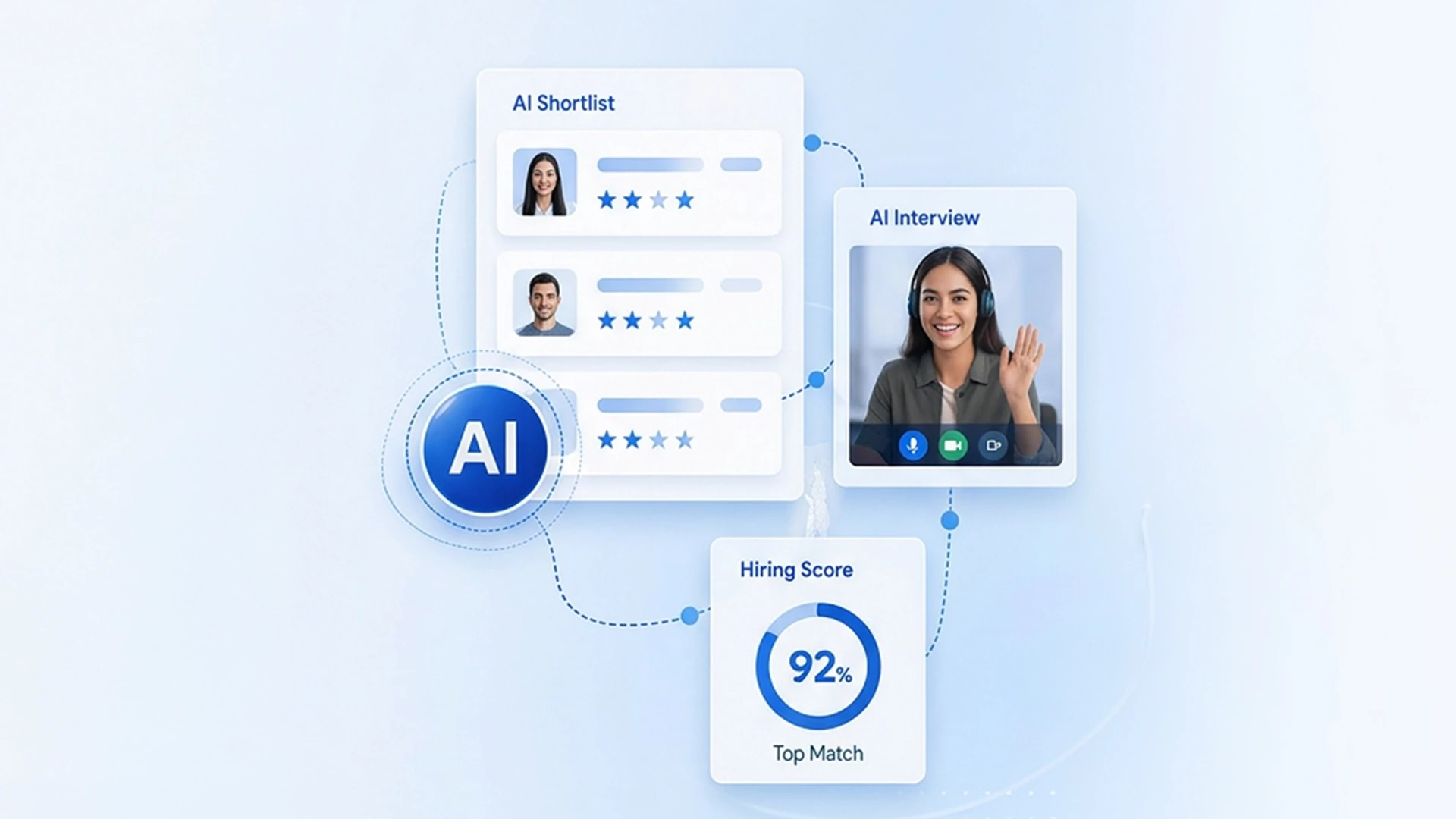
Recruiters today are handling more applications than ever before.
For a single role, hiring teams may receive hundreds of resumes within days. Reviewing each application manually takes time, slows down hiring, and increases the chances of missing qualified candidates.
This is why resume scoring has become an important part of modern recruitment.
Take Ahmed, an HR manager at a growing GCC company hiring across operations, customer support, and sales roles. His recruitment team struggled with screening large numbers of applications quickly while still maintaining hiring quality.
The challenge was not finding candidates. It was identifying the right ones fast enough.
Resume scoring helps solve this problem.
Resume scoring is the process of evaluating resumes against specific job requirements using predefined criteria.
Modern recruitment systems use AI and automation to compare candidate profiles with the role being hired for. Based on this comparison, resumes receive a score that indicates how closely they match the position.
A higher score usually means the candidate is more aligned with the required skills, qualifications, and experience.
Instead of manually reviewing every application equally, recruiters can prioritize candidates with stronger matches first.
For Ahmed’s team, this reduced screening workload significantly and improved hiring speed.
Resume scoring systems analyze multiple elements within a resume.
This often includes skills, work experience, education, certifications, and keywords related to the role.
The system then compares this information against the job description.
For example, if a company is hiring for a customer support role, the platform may prioritize resumes mentioning customer handling, communication skills, CRM tools, or support experience.
This is where the relationship between the resume with job description becomes important.
The closer the resume aligns with the role requirements, the stronger the score becomes.
Modern AI-powered systems go beyond simple keyword matching. They also understand related skills and contextual meaning, helping recruiters identify qualified candidates even when wording differs slightly.
Recruitment teams are under constant pressure to move faster.
Manually screening hundreds of resumes creates delays and increases recruiter fatigue. Important candidates may get overlooked simply because recruiters do not have enough time to review every application carefully.
Resume scoring improves efficiency by helping recruiters focus on the most relevant candidates first.
For Ahmed, this meant recruiters spent less time sorting applications manually and more time interviewing qualified candidates.
It also improved consistency in screening.
Without structured scoring, recruiters may evaluate resumes differently depending on workload, time pressure, or personal interpretation. Resume scoring introduces a more organized evaluation process.
Most resume scoring processes happen inside an applicant tracking system.
An ATS automatically scans and organizes resumes while comparing candidate profiles against job requirements.
This is where resume ATS score check tools become valuable.
These systems help recruiters understand how well candidates align with the position before interviews even begin.
For candidates, ATS score checks are often used to optimize resumes before applying for jobs. For recruiters, they help prioritize applications more efficiently.
Ahmed’s team used ATS scoring to reduce screening bottlenecks during high-volume hiring campaigns.
Instead of reviewing every application manually, recruiters could quickly identify stronger matches and move them forward faster.
One common misconception is that resume scoring fully automates hiring decisions.
That is not true.
Resume scoring is designed to support recruiters, not replace them.
A high score does not guarantee a perfect candidate. Likewise, a lower score does not automatically mean someone is unqualified.
Recruiters still evaluate communication skills, culture fit, leadership ability, and practical experience during interviews and assessments.
The purpose of resume scoring is to simplify early-stage screening and reduce repetitive manual work.
The accuracy of resume scoring depends heavily on the quality of the job description.
If job descriptions are unclear or overloaded with unnecessary requirements, scoring systems may produce weaker results.
Recruiters should focus on:
This improves the alignment between the resume with job description and helps scoring systems identify stronger candidates more accurately.
For Ahmed’s team, refining job descriptions improved both candidate quality and screening efficiency.
Resume scoring creates several practical advantages for recruitment teams.
First, it speeds up hiring workflows. Recruiters can identify relevant candidates faster without manually reviewing every application.
Second, it improves organization. Candidate ranking creates a clearer structure for screening and shortlisting.
Third, it helps reduce recruiter workload. Administrative effort decreases significantly when systems automate early-stage evaluation.
Finally, it improves scalability. Hiring teams can manage larger applicant volumes without increasing operational pressure.
For businesses hiring at scale, these benefits become extremely valuable.
Resume scoring is useful, but it is not perfect.
Over-reliance on keyword matching can sometimes overlook strong candidates with unconventional experience or resume structures.
This is why modern AI systems increasingly focus on contextual understanding rather than exact phrasing alone.
Recruiters should also avoid depending entirely on scores without reviewing candidate backgrounds carefully.
Human evaluation still matters.
The strongest hiring processes combine automation with recruiter judgment.
Platforms like SIAA combine AI-powered resume scoring with applicant tracking and recruitment automation features.
Instead of manually filtering large numbers of resumes, recruiters can use AI matching and ATS scoring tools to identify stronger candidates faster.
SIAA helps hiring teams organize candidate pipelines, automate screening workflows, and improve recruitment visibility within one centralized platform.
Explore the platform here:
SIAA Applicant Tracking System
“Resume scoring helps recruiters spend less time searching and more time selecting the right talent.”
Resume scoring is changing how recruiters manage hiring.
As application volumes continue increasing, manual resume screening becomes harder to sustain. Resume scoring helps recruiters simplify early-stage evaluation, improve efficiency, and focus more on qualified candidates.
The goal is not to replace recruiters with automation.
It is to help hiring teams make faster and more structured decisions while maintaining hiring quality.
Businesses that combine AI-powered resume scoring with strong recruiter judgment will build more efficient and scalable hiring processes.
Discover how SIAA’s AI powered ATS can simplify recruitment for your team.
TRY FOR FREE
Hire Faster, Hire Smarter, Hire with Confidence.
© SIAA. All rights reserved.